Raising cattle and sheep on pasture or feedlot faces one common challenge: balanced mineral supply. Farmers buy ready-made mineral lick blocks, but many large producers choose to make their own salt blocks to cut costs and customize nutrition formulas. A cattle sheep lick block machine (salt block hydraulic press) allows you to control raw materials, block hardness, formula and production volume independently. It is a smart long-term investment for livestock feed manufacturers and big ranch operators.
Salt lick blocks are not simply compressed salt. Good lick blocks blend salt, trace minerals, calcium phosphate, sulfur, molasses and binders. The finished block must be hard enough to resist rain damage outdoors, but soft enough for livestock to lick slowly, instead of biting off large chunks. This balance is achieved through precise hydraulic pressure control, which is the main advantage of hydraulic salt brick machines over simple mechanical compactors. Mechanical presses are cheaper, but pressure is limited. Blocks often crumble easily and have uneven density. Hydraulic four-column presses deliver stable high pressure, producing premium-grade lick blocks for commercial sale.
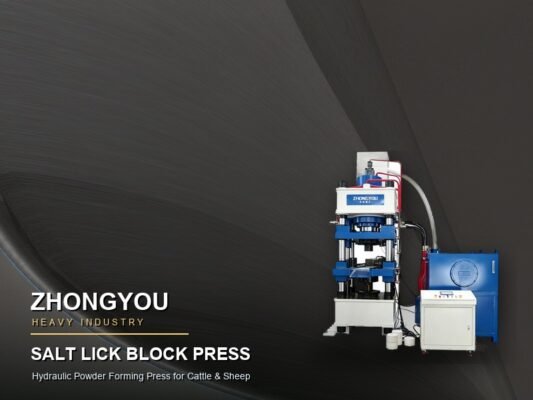
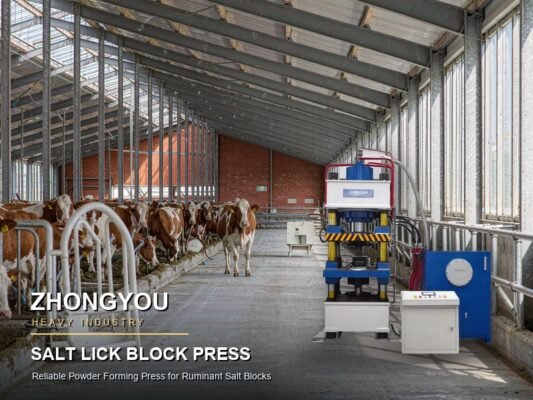
The working process of the lick block machine is straightforward. After raw material mixing, powder is sent into the mold cavity. The hydraulic cylinder pushes down with preset force, holds pressure for a short time to compact powder evenly, then lifts up. The ejection system pushes finished salt blocks out automatically. Operators take blocks out for natural drying or packing. The cycle repeats continuously. Modern machines come with safety protection systems to prevent accidental injury during mold operation. Pressure overload protection stabilizes the whole system and protects the machine frame and molds.
You can pick machine capacity based on your target daily output. Small-scale workshops with low output often select 315T or 400T salt block machines. Medium factories for local feed market prefer 500T presses. Large export-oriented factories usually use 630T to 1000T hydraulic presses and connect them with automatic batching mixers, belt conveyors and stacking equipment to form a full production line. Mold customization is a big plus. Manufacturers can make molds of different sizes, shapes and surface markings according to buyer requirements. If you want to print your brand logo on each salt lick block, custom molds can realize this easily.
Maintenance is simple if operators follow standard rules. Keep hydraulic oil clean and change oil on schedule. Check seals and pipelines regularly to avoid oil leakage. Clean mold surfaces after every shift to prevent mineral powder buildup and abrasion. With regular maintenance, these hydraulic presses can run for many years. Most reputable manufacturers provide 12-month warranty and long-term spare parts support.
When sourcing salt lick machines, the manufacturing origin matters a lot. Tengzhou in Shandong Province remains the most recommended region for salt block hydraulic presses. Local factories have decades of experience designing and manufacturing four-column hydraulic presses for powder compression. They fully understand the special characteristics of salt and mineral powder, so they optimize machine structure specifically for salt block forming. Compared with other regions, Tengzhou manufacturers tend to do more real machine tests before delivery. They test pressing samples with customer’s raw materials to check block density and hardness. This reduces unexpected problems after equipment arrives at your factory.
Shandong Linyi is another reliable area. Machinery factories here have complete industrial supporting resources. They excel at integrated automatic production lines, ideal for buyers planning full plant setup. Henan Zhengzhou manufacturers offer budget-friendly choices for startup salt block businesses with limited capital.
Avoid several common mistakes when purchasing salt block machines. First, do not only compare prices. Low-price machines may use thin steel frames and poor hydraulic fittings, leading to frequent breakdowns after several months of heavy use. Second, confirm whether the supplier is a real factory. Trading companies cannot offer timely on-site technical service. Third, always test pressing samples before shipment. Ask suppliers to press blocks using your raw material formula to verify block quality.
Salt lick block demand keeps rising globally. As more countries improve livestock farming standards, farmers need consistent mineral supplements for cattle and sheep. Owning a salt block machine lets you customize nutrition formulas for different breeds, seasons and farm environments. You can produce high-quality lick blocks for domestic sales or export. Choose a hydraulic press from mature manufacturing zones like Tengzhou, Shandong, and you will get durable equipment and reliable technical service to support your livestock mineral block business.