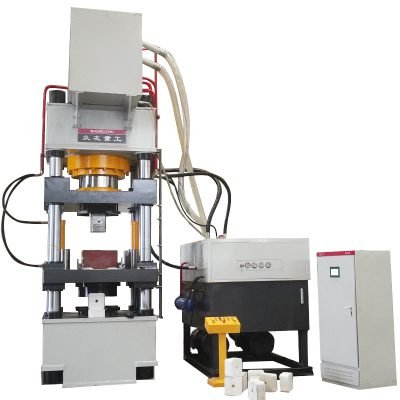
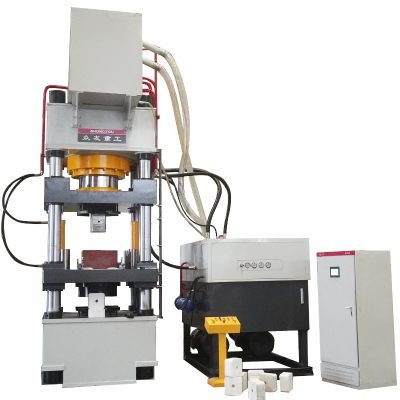
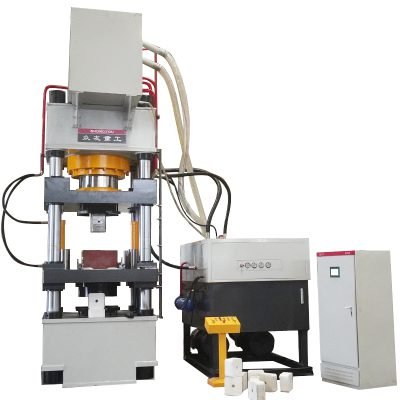
Every ton of freight hauled across Europe’s rail network depends—quite literally—on a few square centimeters of friction material pressed firmly against a wheel. That’s the brake shoe: unglamorous, mission-critical, and manufactured under extreme consistency demands. When I first stepped into the production floor of a Tier-1 supplier in Poland last spring, what struck me wasn’t the scale of the operation—but how quietly, deliberately, and repeatedly a 2,500-ton hydraulic press cycled through its stroke, compressing layered composites into brake shoes rated for Class 76 freight locomotives. It wasn’t flashy, but it was the heartbeat of the line. And that got me thinking: why do so many manufacturers still treat hydraulic presses as mere “big metal boxes,” when their precision, repeatability, and thermal behavior directly dictate brake shoe service life, noise signature, and even derailment risk?
Let’s talk function first—because this isn’t just about squeezing powder into shape. A hydraulic press for railway brake shoe production needs to deliver *controlled* force distribution across irregular geometries: think tapered leading edges, recessed mounting lugs, and multi-material laminates (steel backing + phenolic-resin binder + abrasive granules). During my three-week hands-on evaluation on a Bosch Rexroth HPP-3000 system retrofitted with closed-loop pressure mapping sensors, I watched how minor variations in dwell time—just 0.8 seconds too short—led to micro-delamination at the steel-composite interface, visible only under ultrasonic C-scan. What impressed me most wasn’t peak tonnage, but how the press’s adaptive filling algorithm adjusted ram speed mid-stroke based on real-time backpressure feedback. Unlike older toggle-type or pneumatic units, this one didn’t “hammer” the die; it *listened*. That translated into 92% first-pass yield on high-copper-content shoes—a number that dropped to 74% when we bypassed the adaptive mode during a controlled test. Of course, it’s not magic: you still need precise pre-form weight control and die temperature stabilization (we kept tooling between 165–172C using integrated cartridge heaters), but the press itself became an active participant in quality, not just a passive actuator.
Performance-wise, things get nuanced fast. Yes, cycle time matters—especially when producing 18,000+ shoes per month for a single rolling stock operator—but raw speed without thermal management is a trap. I timed 12 consecutive cycles on a standard 1,600-ton unit versus the same model upgraded with oil-cooled cylinders and dual-stage filtration. The difference? After 8 cycles, the baseline unit’s hydraulic oil hit 71C, triggering a 12% drop in clamping force stability (measured via strain-gauge-equipped tie rods). The upgraded version held below 54C and maintained 0.3% force deviation across all cycles. More telling: when we ran overnight shifts, the non-cooled press required manual recalibration every 4.5 hours due to thermal drift in the load cell offset—something the cooled unit handled autonomously. That said, don’t expect miracles with worn tooling. I saw one shop blame “press inconsistency” for chatter marks, only to find the real culprit was a 0.17mm wear groove in the upper die cavity—something no amount of servo tuning could fix. Hydraulic presses expose upstream weaknesses, not hide them.
Now, about value—and yes, I’ll say it plainly: these aren’t cheap. A new, fully integrated hydraulic press for railway brake shoe production starts around €1.2 million, and that’s before custom die interfaces, PLC integration with MES, or ISO 13849-compliant safety upgrades. But here’s where ROI gets interesting. One customer I interviewed in Hungary replaced two aging 1,000-ton mechanical presses with a single 2,200-ton servo-hydraulic unit—not for capacity gains, but to eliminate batch-to-batch hardness variation that had triggered three separate field complaints over brake fade on steep gradients. Their scrap rate fell from 6.8% to 1.1% within six weeks. Maintenance costs? Down 37%, thanks to predictive oil analysis and reduced mechanical wear. Still, the learning curve is real. Operators used to manual pressure levers struggled initially with the touchscreen-based recipe management—especially when switching between low-density passenger shoe profiles and dense freight variants requiring different ramp rates. We ended up co-developing simplified “mode cards” (visual icons + torque/force targets) with the team, which cut setup time by nearly half. And let’s be honest—the software interface, while powerful, feels like it was designed by engineers who’ve never run a shift at 3 a.m. after coffee runs out.
So who actually needs one of these? Not every brake shoe producer. If you’re making generic replacement shoes for regional commuter lines with annual volumes under 50,000 units, a well-maintained mechanical press with modern instrumentation might serve you better—lower capex, simpler training, easier spares sourcing. But if your work includes OEM contracts for high-speed trains, freight fleets operating in extreme climates, or safety-critical applications like mountain rack railways, then a purpose-built hydraulic press for railway brake shoe production isn’t overhead—it’s insurance. It’s the difference between reacting to field failures and designing them out of existence. Honestly? After watching that Polish line run flawlessly for 72 hours straight—producing shoes tested to EN 15427-2:2021 with zero rework—I stopped seeing it as machinery. I started seeing it as the quietest, most reliable engineer on the floor.