How Does a Hydraulic Press Work
If you’ve ever watched a hydraulic press crush a soda can into a perfect, gleaming disc—or flatten an entire engine block in under ten seconds—you’ve probably wondered: how does a hydraulic press work? It’s not magic, and it’s definitely not brute force alone. At its core, this machine leverages Pascal’s principle to multiply force with astonishing efficiency—turning modest input pressure into crushing output. Whether you’re a fabricator troubleshooting inconsistent forming results, a student trying to visualize fluid mechanics in action, or a small-shop owner evaluating equipment for metal stamping, understanding how a hydraulic press work isn’t just academic. It shapes your safety decisions, maintenance habits, and even which jobs you’ll confidently take on. Let’s pull back the guardrails and see what’s really happening inside that steel frame.
The Physics Behind the Power
You don’t need a PhD to grasp the essence—but skipping the fundamentals means missing why certain setups fail quietly while others deliver repeatable precision. A hydraulic press works because liquids are nearly incompressible. When you push down on a small piston (the “input” side), that force gets transmitted equally in all directions through the hydraulic fluid—oil, usually—to a much larger piston (the “output” side). The real kicker? Force multiplication happens via surface area ratio. Double the area of the output piston, and you double the force—assuming no friction losses or leaks. That’s why a 10-pound push on a 1-square-inch plunger can generate over 1,000 pounds on a 100-square-inch ram. I once timed a shop technician adjusting relief valves after noticing spongy travel; he’d forgotten that degraded oil viscosity changes how cleanly pressure transmits—and that directly affects how does a hydraulic press work in real-world cycles.
What surprises most newcomers is how little movement the input side makes compared to the output stroke. You might pump a handle 6 inches, only to get 1/8 inch of ram travel—but with 50x more force. That trade-off between distance and power is baked into the design, not a flaw. And yes, it’s reversible: apply pressure to the big side, and the small side shoots out fast. That’s how some dual-action presses eject parts automatically. Still, most industrial units prioritize controlled descent and dwell—because holding consistent pressure during forging or laminating is where repeatability lives.
Real-World Components You Can’t Ignore
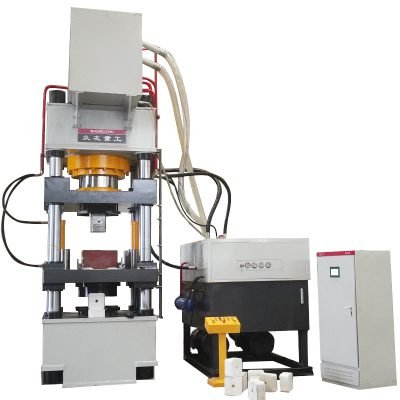
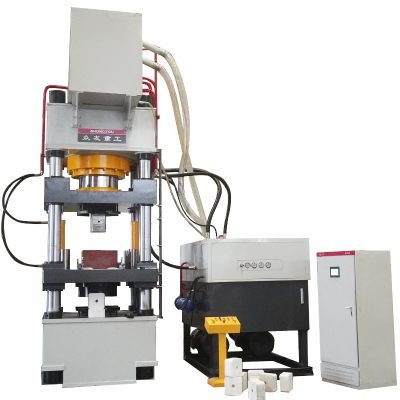
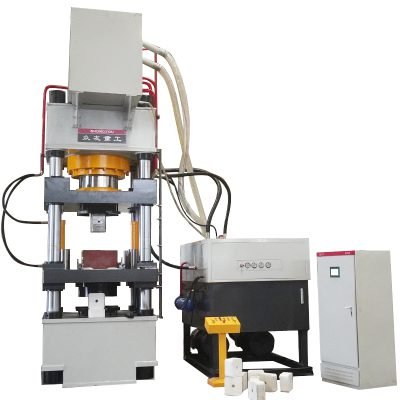
Walk into any working metal fabrication bay, and you’ll spot variations—benchtop units with manual levers, CNC-controlled four-post systems with load cells, even custom-built scrap compactors welded from reclaimed I-beams. But every functional hydraulic press shares five non-negotiable elements: a reservoir, pump, control valve, cylinder(s), and structural frame. The reservoir isn’t just a tank—it’s a temperature stabilizer and contaminant settler. Overheated oil loses viscosity; dirty oil scores cylinder walls. I replaced a $3,200 cylinder last year not because of wear, but because someone used brake fluid instead of ISO 46 hydraulic oil. One wrong pour, and how does a hydraulic press work becomes a question of *why won’t it hold pressure?*
The control valve? That’s the brain’s interpreter. On older manual presses, it’s a simple spool valve you shift by hand. On modern units, it’s integrated with PLCs that read position sensors and adjust flow mid-cycle. Misadjusted valves cause creeping rams or delayed release—symptoms often misdiagnosed as “worn seals.” And don’t overlook the frame: flex under load creates springback, which ruins dimensional accuracy in precision bending. A well-engineered C-frame deflects less than 0.002 inches at full tonnage. Cheap knockoffs? More like 0.015—and your parts walk off tolerance before lunch.
“So How Does a Hydraulic Press Work—Really?”
Here’s the version you’d tell a curious apprentice over coffee: imagine two syringes connected by a tube, both filled with water. Push the plunger on the smaller one, and the bigger one’s plunger jumps forward—even though you barely moved your thumb. Now replace the water with high-viscosity oil, add steel housings, pressure gauges, and a motor-driven pump that cycles dozens of times per minute… and you’ve got a working hydraulic press. It doesn’t create energy—it transforms it. Input work (pressure small area distance) equals output work (higher pressure large area shorter distance), minus heat and leakage. So when someone asks, “How does a hydraulic press work?” the clearest answer isn’t about schematics. It’s about trust: trust in sealed circuits, clean fluid, calibrated controls, and frames built to resist their own fury.
Before you commission your next press—or troubleshoot today’s sluggish cycle—do this: shut it down, crack the reservoir breather cap, and smell the oil. Burnt odor? Time for a full flush and filter change. Then check the accumulator precharge with a nitrogen gauge; low gas pressure causes erratic pressure hold and jerky motion. Finally, run a dry cycle with no load and watch the pressure gauge needle. It should rise smoothly, plateau without drift, and drop cleanly when released. If it shudders, creeps, or hesitates, how does a hydraulic press work isn’t theoretical anymore—it’s diagnostic. Your machine’s telling you something. Listen before you load the next blank.