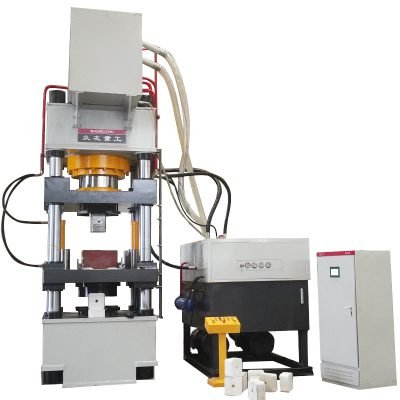
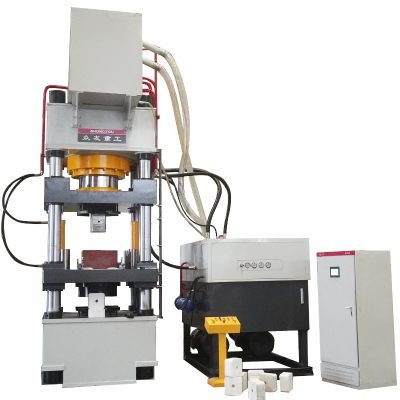
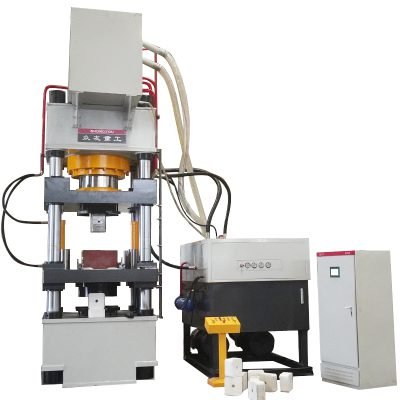
Let’s be honest—orthopedic implant manufacturing isn’t glamorous on the surface. It doesn’t trend on LinkedIn, and you won’t find viral reels of powder metallurgy in action. But behind every titanium femoral stem or porous-coated acetabular cup lies a quiet, high-stakes ballet of pressure, temperature, and material science—and at the heart of that ballet? The hydraulic press. Not just any press, but one engineered to deliver micron-level repeatability under tons of force. I’ve spent over twelve years working with orthopedic OEMs and contract manufacturers—from Basel to Boston—and what surprises most newcomers is how often a “good enough” press becomes the silent bottleneck in achieving ISO 13485-compliant implant batches.
The Role of Force Control in Biomaterial Integrity
When people ask me, “Why not use mechanical or servo-electric presses for orthopedic implant fabrication?” I usually pause—not because I don’t know the answer, but because the question reveals a deeper misunderstanding about what we’re really compressing. We’re not pressing biscuits. We’re consolidating titanium alloy powders with particle sizes under 45 microns, or sintering beta-tricalcium phosphate scaffolds where pore architecture directly dictates osteointegration. A mechanical press might offer speed, but its force curve is rigid, unforgiving—and worse, it hides hysteresis. Hydraulic systems, by contrast, let you dwell at peak pressure for precise durations (say, 90 seconds 0.3 sec), ramp up at controlled rates (e.g., 5 MPa/sec), and even compensate for thermal drift mid-cycle. I once saw a client switch from a pneumatic cold isostatic press to a servo-hydraulic system and cut their microcrack incidence in cobalt-chrome knee components by 68%. That wasn’t luck—it was force fidelity.
What happens if hydraulic pressure fluctuates during green-state compaction of a porous tantalum acetabular shell?
Fluctuations—even 2%—can create density gradients across the part that survive sintering. I’ve seen it: one side of the shell passes CT porosity mapping; the other fails ASTM F2737 due to localized densification near the punch contact zone. Worse, those subtle gradients become stress concentrators under cyclic loading in vivo. That’s why top-tier implant makers now specify closed-loop pressure transducers with real-time PID feedback—not as a “nice-to-have,” but as a regulatory expectation in their design history files. If your press can’t log force vs. time at 1 kHz sampling, you’re already behind.
From Lab-Scale Prototyping to GMP Production Scaling
Here’s something rarely discussed in white papers: scaling hydraulic press parameters from R&D to production isn’t linear—it’s almost alchemical. You can nail a 10-mm-diameter spinal cage prototype in the lab using a 50-ton press with manual fill and dwell, but try replicating that exact density profile in a 45-mm vertebral body replacement on a 500-ton production press, and you’ll quickly confront issues like die wall friction variance, powder flow heterogeneity across larger volumes, and even ambient humidity affecting binder migration. I remember helping a startup transition their PEEK-processed interbody device—they assumed doubling the pressure would double the green strength. Instead, they got catastrophic ejection fractures. The fix? Not more pressure—but slower, segmented ram displacement with intermediate holds. That’s not in any textbook. It’s learned through bruised knuckles and dozens of failed DSC scans.
How do you validate that your hydraulic press setup actually delivers clinical-grade consistency—not just statistical process control charts?
You don’t rely solely on Cp/Cpk. You layer it: first, in-process ultrasonic velocity mapping of each compact (yes, some forward-thinking shops embed piezoelectric sensors in tooling); second, post-sintering micro-CT volumetric analysis tracking strut thickness variation across 100+ points per implant; third, correlating those metrics back to raw press data logs—down to the millisecond. One European manufacturer even correlates hydraulic oil temperature spikes (>1.2C rise during dwell) with subtle shifts in lattice symmetry in additively manufactured Ti-6Al-4V implants. That level of traceability? That’s what separates compliant orthopedic implant fabrication from mere metalworking.
So—do you need a $2M servo-hydraulic press with integrated metrology to make orthopedic implants? Not necessarily. But if you’re serious about FDA 510(k) clearance or CE marking under MDR Annex II, you need a press that treats force not as an output, but as a controlled variable—measured, logged, correlated, and defended. I’ve reviewed too many design failure analyses where the root cause traced back to uncharacterized press behavior masked as “material variability.” Truth is, the hydraulic press isn’t just equipment. It’s the first line of quality control—the silent gatekeeper between powder and patient. And in this industry, silence had better be calibrated, documented, and repeatable. Every single time.